
If you have searched for tubefalire, you may have noticed that the term does not have one consistent explanation. Some websites describe Tubefalire as a general digital failure involving software, uploads, streaming, servers, or online workflows, while other pages connect the keyword with content performance or broader technology concepts. This makes it difficult to determine whether Tubefalire is an actual technology, a software product, an established technical expression, or simply an emerging internet keyword.
The safest way to understand Tubefalire is to separate documented facts from interpretations. Current online articles use the word in several different ways, but it does not appear to have the status of a standardized computer-science or engineering term. At the same time, “tube failure is a legitimate engineering expression used when discussing damaged or failed tubes in equipment such as boilers and heat exchangers. This guide explains the different meanings currently associated with Tubefalire, what can actually be verified, common digital-failure scenarios, and the important distinction between Tubefalire and genuine tube failure.
What Is Tubefalire?
Tubefalire is an unofficial internet term whose meaning varies between online sources. It is not currently supported by one universally accepted technical definition, product specification, academic definition, or recognized industry standard.
Several recently published articles use Tubefalire as a broad description for digital problems. These include interrupted uploads, software crashes, synchronization problems, failed online processes, server communication issues, and streaming interruptions. Other articles present it as a broader concept involving digital performance, content delivery, or system reliability.
This variation is important because a reader should not automatically accept one definition as established fact. A recent review of the keyword found that online sources provide contradictory explanations and that there is no clearly documented origin establishing one official meaning.
In practical terms, Tubefalire is best treated as an unverified or informal search term rather than the name of a specific technology. If you encounter the word in an article, the surrounding context matters more than the word itself.
Why the Meaning of Tubefalire Is Difficult to Verify
The biggest issue with Tubefalire is not a lack of articles. There are actually many pages discussing it. The problem is that those pages do not consistently agree about what the word represents.

Some sources describe it as a general digital failure concept, while others connect it to video platforms, content performance, system reliability, or technical breakdowns. For example, one recent explanation describes Tubefalire as a broad label for recurring digital failures, while another presents it as a concept related to video ecosystems and content delivery.
That disagreement creates several possibilities:
- Tubefalire may be an informal internet expression.
- It may have developed from a spelling variation or misunderstood phrase.
- Different publishers may be assigning their own definitions to the keyword.
- It may be used as a broad SEO term rather than a formally defined technical concept.
- Some uses may be influenced by confusion with “tube failure.
- The meaning may continue changing as more websites use the term.
None of these possibilities should be presented as a proven origin unless a reliable primary source establishes it.
Tubefalire as a Digital Failure Concept
One of the most common explanations found online treats Tubefalire as a general description of a digital process that does not work as expected.
This interpretation is relatively easy to understand because modern digital services depend on many connected components. A user may see one visible problem, but the underlying cause can exist somewhere else in the system.
For example, a user may experience:
- An upload stopping before completion
- A download repeatedly failing
- An application freezing
- A website becoming temporarily unavailable
- A video buffering unexpectedly
- Cloud synchronization stopping
- A login session ending unexpectedly
- A file failing during processing
- A server connection being interrupted
- A digital workflow becoming stuck
These are real types of technology problems, but calling every one of them “Tubefalire does not make that word an official technical classification.
A better interpretation is that some online writers are using Tubefalire as an informal umbrella term for digital disruption. Recent articles make this association repeatedly, particularly when discussing incomplete workflows and unexpected system behavior.
view more articles:
- Betterthisworld Money
- Nai Taiyari
- Shortminde com Review
- Vocalnewsmedia com Review
- Contact Gonzay com
- Glorvix com Review
- Adswynk com Review
- Is Crackstube Safe
- Dreamwithjeff com
- Betterthisworld Money
- Techyhittools org
- Lectfect com
- Mercimek Kofte Near Me
Common Causes Behind Digital Failures Associated With the Term
When Tubefalire is used to describe digital problems, the actual cause should be investigated rather than assuming that the unusual keyword identifies the problem.
Digital systems can fail because multiple layers interact with one another. A device, network, application, database, server, authentication service, and external API may all contribute to one workflow.
Common underlying causes include:
- Unstable internet connections: Packet loss or inconsistent connectivity can interrupt uploads, downloads, streaming, and synchronization.
- Server-side problems: An overloaded or unavailable server can prevent an otherwise functional application from completing a request.
- Software bugs: Incorrect application behavior can cause crashes, freezes, or failed processes.
- Compatibility conflicts: Different software versions, plugins, browsers, or operating systems can interfere with normal operation.
- Insufficient resources: Low storage, memory, processing capacity, or bandwidth can affect performance.
- Authentication failures: Expired sessions or invalid credentials can interrupt processes that require continuous authorization.
- Corrupted files: Damaged or incomplete data can prevent processing or synchronization.
- Configuration errors: Incorrect settings can create failures even when the underlying hardware and software are working correctly.
- Third-party service outages: Modern applications often depend on external services, meaning one unavailable dependency can affect the entire workflow.
- Excessive traffic: Sudden demand can create delays, timeouts, or temporary service degradation.
Understanding the actual cause is much more useful than simply applying the label Tubefalire.
Tubefalire and Online Video or Streaming Discussions
Another interpretation appearing online connects Tubefalire with video platforms, streaming performance, content delivery, and digital media ecosystems. One recent source describes the term as an emerging concept around video-platform behavior and unpredictable content or delivery performance.
This interpretation can involve problems such as delayed playback, interrupted delivery, poor engagement, failed processing, or inconsistent platform performance. However, there is an important distinction between a real technical problem and the label used to describe it.
Video streaming can genuinely experience:
- Buffering
- Network congestion
- Encoding problems
- Server-side interruptions
- Content delivery delays
- Device compatibility issues
- Browser-related problems
- Authentication errors
- Bandwidth limitations
- Temporary platform outages
Those are established technical situations. Tubefalire is not required as a technical diagnosis for any of them.
Therefore, if an article describes Tubefalire as a formal streaming technology, users should look for supporting documentation from the relevant platform or technology provider before accepting that claim.
Tubefalire Is Not a Recognized Software Product
Another common misunderstanding is assuming that Tubefalire is the name of a specific application, platform, or software service.
There is currently no strong evidence establishing Tubefalire as a universally recognized software product with an official technical specification. Current articles instead describe it as a concept, label, or informal expression.
This distinction matters for people searching for:
- A Tubefalire login
- Tubefalire software
- Tubefalire downloads
- Tubefalire documentation
- Tubefalire customer support
- Tubefalire pricing
- Tubefalire installation instructions
Before entering credentials, downloading software, or providing personal information to a website claiming to represent Tubefalire, verify that the service has a genuine official identity and trustworthy documentation.
An unfamiliar keyword by itself is not evidence that a legitimate company or application exists behind it.
Tubefalire vs. Tube Failure
The most important terminology distinction is between Tubefalire and tube failure.
“Tube failure is a well-established engineering concept. Engineers use the term when analyzing damaged tubing in equipment such as heat exchangers, boilers, condensers, and industrial systems. Research and engineering literature document failure mechanisms including corrosion, erosion, fatigue, creep, vibration, overheating, and other forms of material degradation.
By contrast, Tubefalire is an informal keyword with no similarly established technical definition.
| Tubefalire | Tube failure |
| Informal or disputed internet term | Established engineering term |
| Meaning varies between websites | Meaning is technically defined |
| Often associated online with digital problems | Associated with physical equipment and tubing |
| No clearly established technical standard | Documented in engineering literature |
| May represent different interpretations | Used for actual failure analysis |
| Origin is unclear | Used for decades in engineering contexts |
This distinction is especially important if you arrived at Tubefalire while researching industrial equipment.
What Causes Actual Tube Failure?
If your intended search was tube failure, rather than Tubefalire, the subject is considerably better documented.
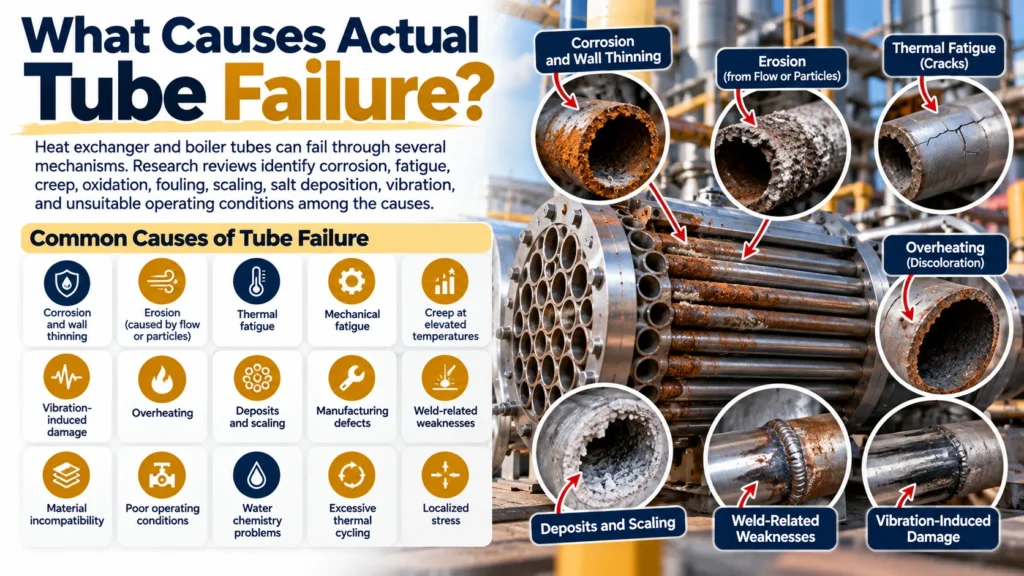
Heat exchanger and boiler tubes can fail through several mechanisms. Research reviews identify corrosion, fatigue, creep, oxidation, hydrogen-related damage, fouling, scaling, salt deposition, vibration, and unsuitable operating conditions among the mechanisms that can contribute to failure.
Industrial investigations may examine:
- Corrosion and wall thinning
- Erosion caused by flow or particles
- Thermal fatigue
- Mechanical fatigue
- Creep at elevated temperatures
- Vibration-induced damage
- Overheating
- Deposits and scaling
- Manufacturing defects
- Weld-related weaknesses
- Material incompatibility
- Poor operating conditions
- Water chemistry problems
- Excessive thermal cycling
- Localized stress
The American Institute of Chemical Engineers describes root-cause analysis as an important part of addressing recurring heat-exchanger tube failures because identifying the mechanism can help prevent repeated incidents.
For boilers, technical guidance also identifies corrosion, overheating, erosion, deposits, thermal stresses, and water chemistry as important considerations when investigating tube damage.
How Engineers Investigate Tube Failure
Actual tube-failure investigations are more involved than simply looking at the location of a leak.
Engineers may examine the damaged component, operating history, material characteristics, temperatures, pressures, fluid chemistry, flow conditions, deposits, and the physical appearance of cracks or wall loss.
Depending on the equipment and suspected mechanism, investigations can involve:
- Visual inspection
- Dimensional measurements
- Metallurgical examination
- Microscopy
- Thickness measurements
- Ultrasonic testing
- Eddy-current testing
- Magnetic-particle inspection
- Dye-penetrant testing
- Radiographic examination
- Chemical analysis
- Fracture analysis
- Review of operating records
A review of heat-exchanger failures notes that several nondestructive testing methods can be used to identify or assess tube damage, including eddy current, hydrostatic testing, magnetic-particle testing, ultrasonic testing, radiography, penetrant testing, and thermography.
This is why replacing a damaged tube without investigating the underlying mechanism may not solve the larger reliability problem.
How to Approach a Tubefalire Search Safely
Because the keyword has inconsistent meanings, searchers should first determine what they are actually trying to find.
A practical approach is:
- Check the context: Look at the sentence where Tubefalire appears.
- Identify the subject: Determine whether the page is discussing software, streaming, content, or engineering.
- Look for a primary source: Prefer documentation from an identifiable organization or manufacturer.
- Separate claims from evidence: A confident article does not automatically make its definition authoritative.
- Search alternative spellings: Consider whether you intended “tube failure or another similar phrase.
- Check technical terminology: For engineering questions, use established industry terminology.
- Avoid unnecessary downloads: Do not install unknown software simply because a page associates it with Tubefalire.
- Protect login information: Verify the identity of a service before entering credentials.
- Compare multiple sources: Consistent independent documentation is stronger evidence than several similar blog posts.
- Look for dates: Recently published pages may reflect an emerging internet trend rather than an established definition.
This approach is particularly useful for unusual keywords that appear suddenly across multiple low-authority websites.
Why Search Results Can Produce Conflicting Tubefalire Definitions
Search engines organize information based on many signals, and an unusual keyword can produce a mixture of related interpretations.
If multiple publishers create pages around the same uncommon term, subsequent articles may reference earlier pages. Over time, several interpretations can appear to reinforce one another even when there is no original authoritative definition.
That does not prove that every Tubefalire article is inaccurate. It simply means that the number of articles using a term is not the same thing as evidence that the term has an official meaning.
The current online landscape illustrates this problem. Some sources describe Tubefalire as digital failure, others describe it as a broader content or performance concept, and some specifically discuss its similarity to tube failure.
For readers, the best response is to evaluate the evidence behind each interpretation rather than choosing the definition that sounds most technical.
Key Facts to Remember About Tubefalire
- Tubefalire does not currently have one universally accepted definition.
- It is frequently described online as an informal digital-failure concept.
- Some sources associate it with streaming, content delivery, or online performance.
- It should not automatically be treated as the name of a software product.
- There is no clear, universally documented origin for the term.
- “Tube failure is a separate and established engineering expression.
- Actual tube failures occur in equipment such as boilers and heat exchangers.
- Corrosion is one important mechanism involved in real tube failures.
- Erosion, fatigue, creep, overheating, and vibration can also contribute to tube damage.
- Engineering investigations focus on root causes rather than relying on a generic label.
- A search result alone cannot establish a technical definition.
- Primary documentation is more reliable than unsupported blog explanations.
- Users should be cautious with websites claiming to offer Tubefalire software or services.
- The intended meaning should always be determined from context.
- If you meant industrial “tube failure, that phrase is the more accurate search term.
Conclusion
Tubefalire is best understood as an emerging and unofficial internet keyword rather than a clearly established technical term. Online sources currently associate it with several ideas, particularly digital failures, interrupted workflows, streaming behavior, content performance, and system reliability. However, these interpretations are not supported by one universally accepted definition, so readers should be careful about treating a single blog’s explanation as an established fact.
The situation is much clearer when the intended phrase is “tube failure. That is a legitimate engineering subject with documented failure mechanisms, investigative methods, and technical literature covering boilers, heat exchangers, and other industrial equipment. If you encountered Tubefalire while researching technology, use the surrounding context to determine what the author means; if your subject is industrial equipment, searching for tube failure will provide a substantially more reliable technical pathway.
What does Tubefalire mean?
Tubefalire is an unofficial internet term that different websites currently use in different ways. Many recent articles associate it with digital failures, interrupted workflows, streaming problems, or broader online performance issues, but there is no single established definition.
Is Tubefalire an official technology term?
There is currently no strong evidence that Tubefalire is an officially standardized computer-science, cybersecurity, or engineering term. Current explanations largely come from independent online articles rather than a recognized technical standard.
Is Tubefalire the same as tube failure?
No. “Tube failure is a genuine engineering term referring to the failure of tubes used in equipment such as boilers and heat exchangers. Tubefalire is a separate, inconsistently defined internet keyword.
Is Tubefalire a software or application?
There is no clear evidence establishing Tubefalire as a universally recognized software application or official technology product. If a website claims to offer a Tubefalire service, verify its ownership, documentation, security, and authenticity before using it.
Why do websites give different meanings for Tubefalire?
The term appears to have developed without a clearly documented authoritative definition. As different publishers use it for different concepts, search results can contain several competing interpretations. It is therefore better to examine the evidence and context instead of assuming one definition is officially correct.