
Millions of people open Connections every morning, and a large share of them go straight to a search engine within four minutes. This guide is for part of that problem: a daily hints page cannot solve understanding how the puzzle is actually built, why the categories overlap the way they do, and what a good solver does differently. Everything here stays true tomorrow, which is more than can be said for today’s answers.
What NYT Connections Actually Is
Connections is a daily wordgrouping puzzle published by The New York Times Games. You are shown sixteen words in a four by four grid and asked to sort them into four groups of four, each sharing a hidden connection. It entered beta on 12 June 2023 and has since become the second most played game the Times publishes, behind only Wordle. The puzzles are written and edited by Wyna Liu, who joined the NYT games department as an associate puzzle editor in 2020 after her first crossword appeared in the paper in 2019.
- A daily puzzle from The New York Times Games
- Sixteen words sorted into four groups of four
- Launched in beta on 12 June 2023
- The second most played NYT game after Wordle
- Written and edited by puzzle editor Wyna Liu
- Free to play on the web and in the NYT Games app
The Rules in Full
The rules are simple to state and much harder to execute. You select four words and submit them. If they form a real group, they lock in with their colour and their category name is revealed. If they do not, you lose one of four lives. Four wrong guesses and the puzzle ends, revealing the solution.
- Select exactly four words and submit them together
- A correct group locks in and reveals its category name
- A wrong guess costs one of your four mistakes
- After four mistakes the puzzle ends and reveals the answers
- One away tells you three of your four are correct
- The puzzle resets at midnight in your own time zone
The Colour System
Each category carries a colour that indicates its intended difficulty, and this ordering is not decorative it is the single most useful piece of information in the game.
- Yellow the most straightforward category, usually a direct link
- Green broader, still fairly plain once you see it
- Blue more abstract or less common
- Purple the hardest, and almost always wordplay
- The colours are only revealed as you solve, not in advance
- Knowing the difficulty ladder exists changes how you should guess
Why Connections Is Harder Than It Looks
Sixteen words and four groups sounds trivial until you try it. The difficulty is deliberate and structural; the puzzle is built so that several words could plausibly belong to more than one category, and the obvious grouping is frequently the trap. Liu is well known among regular solvers for constructing overlaps precisely where a confident solver would stop thinking.
- Words are chosen specifically to fit multiple categories
- The most obvious grouping is often deliberately false
- Overlaps are constructed, not accidental
- Confidence is the most common cause of a lost puzzle
- The puzzle punishes patternmatching and rewards checking
The Overlap Trap
Here is the mechanism in practice. If a puzzle contains a fruit category, it will also contain two or three other words that are technically fruits but belong somewhere else a colour, a surname, a slang term. You spot four fruits, you feel certain, you submit, and you get one away or a straight miss. The four fruits were never the group. They were the bait.
- Extra words that fit a category are placed on purpose
- Spotting four of something is not the same as finding the group
- One away usually means you took the bait
- The real group is often the one you dismissed as too obvious
- Count before you commit this is the core discipline
How to Win A Strategy That Works
The advice below is what separates people who solve most days from people who lose lives early. None of it requires a bigger vocabulary.
Start With Certainty, Not Similarity
Most players start with the words that look related. Better players start with the words they are certain about and work outward. The distinction matters because similarity is exactly what the puzzle manufactures artificially certainty is what it cannot fake.
- Find the group you would bet money on, not the one that looks neat
- If you are not certain, do not submit look again
- Your first submission should be your most confident, not your first idea
- Losing a life on guess one removes your safety margin immediately
The FiveCandidate Rule
This is the most useful single habit in the game. Before submitting, count how many words on the board could belong to your category. If the answer is four, submit. If the answer is five or more, you have found the trap rather than the group, and you need to work out which one is the impostor first.
- Count every possible candidate before submitting
- Exactly four candidates means submit with confidence
- Five or more means the category is a trap
- Identify which candidate belongs elsewhere first
- This single check prevents most avoidable losses
Solve Purple First When You Can
This is counterintuitive and it works. Purple is the wordplay category, and wordplay categories are usually the tightest once you see the trick, all four words are unambiguous. Removing purple early strips four of the trickiest words off the board and makes everything else much cleaner.
- Purple is the hardest to spot but the least ambiguous once seen
- Removing it early eliminates the most misleading words
- The remaining twelve words become far easier to sort
- If you cannot see purple, do not force it move on
- This works best on puzzles where the yellow group feels crowded
Use Shuffle Deliberately
The shuffle button is not decorative. Your brain groups words by their physical position on the grid without your permission, and shuffling breaks that bias. Use it whenever you feel stuck, and use it before your first guess if the layout looks suspiciously tidy.
- Position on the grid creates unconscious grouping bias
- Shuffling breaks visual associations you did not choose
- Use it whenever you stall, not just at the start
- Deselecting and rereading the grid has the same effect
- Costs nothing and never counts against you
How to Read the Purple Category
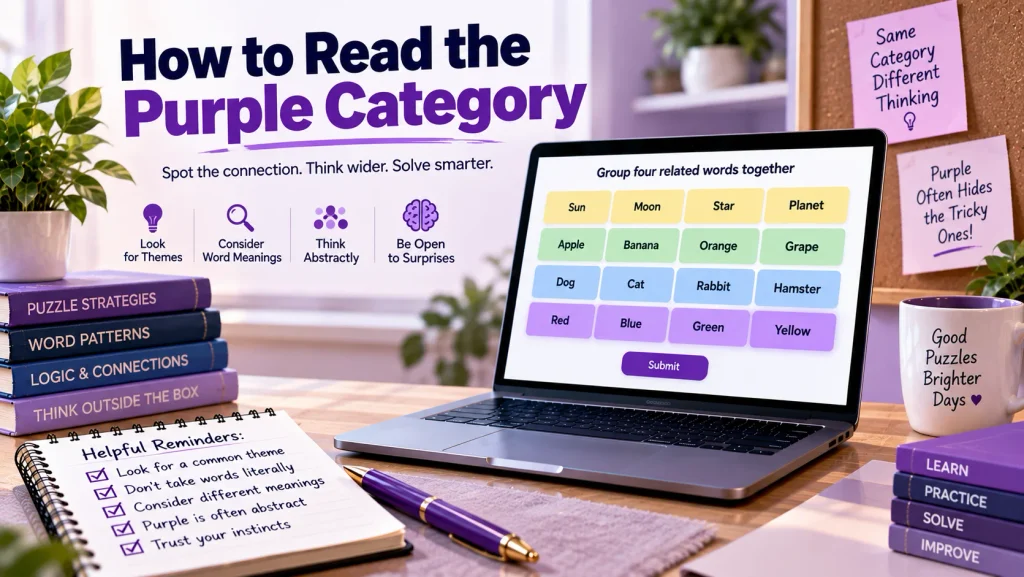
Purple has recognisable patterns, and learning them is the fastest way to improve. The category is almost always about the words themselves rather than what they mean.
- Hidden words a shorter word concealed inside each entry
- Added or removed letters each word becomes another with one change
- Homophones words that sound like something else entirely
- Anagrams rearrangements of a common theme
- Shared prefixes or suffixes all four take the same addition
- ___ + word constructions each pairs with a common term
- If a word seems to belong nowhere, check it for wordplay first
Connections Sports Edition
A separate sports version exists and generates its own substantial search interest, so it is worth being clear about how it differs. Connections Sports Edition is published by The Athletic in partnership with NYT Games. It launched out of beta on 9 February 2025, timed to coincide with Super Bowl LIX, and it is written by Mark Cooper, The Athletic’s managing editor for news, who became its puzzle editor at launch.
- Published by The Athletic with NYT Games
- Officially launched 9 February 2025, timed to the Super Bowl
- Written by Mark Cooper of The Athletic
- Same sixteenword, fourgroup, fourmistake format
- Same yellow to purple difficulty ladder
view more articles:
- Los Boquerones
- Shortminde com Review
- Vocalnewsmedia com Review
- Contact Gonzay com
- Glorvix com Review
- Adswynk com Review
- Is Crackstube Safe
- Dreamwithjeff com
- Betterthisworld Money
- Techyhittools org
How It Differs From the Original
Cooper has described the sports edition as relying more on trivia than the original does, deliberately including at least one trivia based category in each puzzle while keeping the purple group focused on wordplay, as in the main game. Practically, this means sports knowledge helps in a way that general knowledge does not help in the original.
- Leans on sports trivia rather than pure wordplay
- One category per puzzle is usually trivia based
- Purple still tends to be wordplay, as in the original
- It does not appear in the main NYT Games app
- Play it in The Athletic’s app or free on the web
Where the Daily Hints Come From
A large share of Connections searches are for a specific publication’s daily hints page. Several major outlets publish these every single day, usually within an hour or two of the puzzle going live a set of four hints ordered yellow to purple, then the category names, then the answers themselves, staged so you can stop reading at whichever level of help you wanted.
- Multiple large outlets publish daily hints and answers
- Published within an hour or two of the puzzle going live
- Structured in stages hints, then categories, then answers
- Staging lets you take only as much help as you need
- Each day’s page is new yesterday’s is useless today
- The puzzle number identifies which day a page covers
Why These Pages Are Always BrandSpecific
People rarely search for hints in the abstract. They search for a specific outlet’s hints, because they have used that outlet before and know how its staging works. That is a habit rather than a preference for the content, and it is why these searches carry a publication name attached far more often than not.
- Readers develop a habit around one outlet’s format
- The staging style differs slightly between publishers
- Searches usually name the publication, not the puzzle
- This is navigational behaviour rather than informational
- Any daily hints page must be published fresh, every day
How to Use Hints Without Ruining the Puzzle
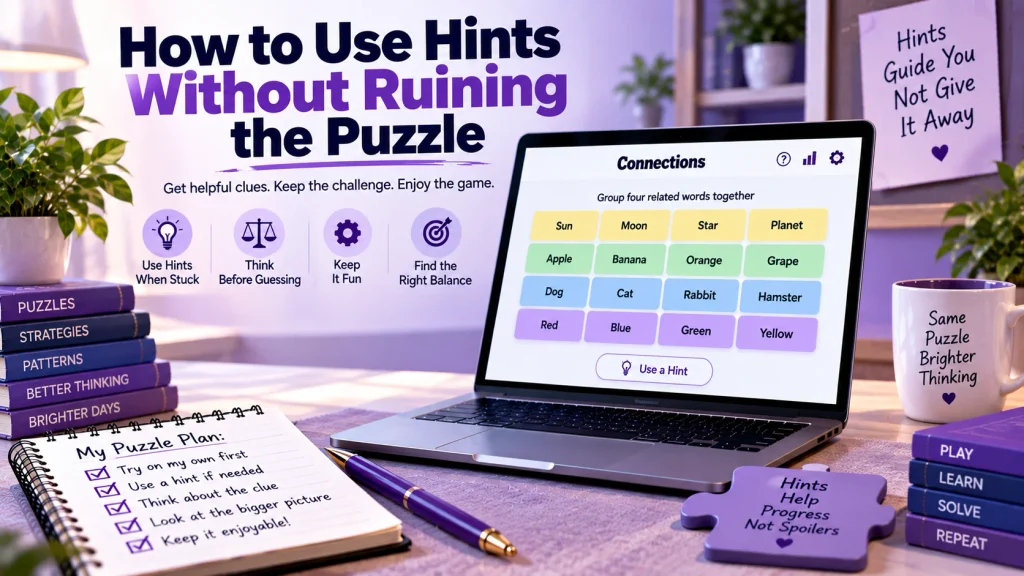
There is a real skill to taking help without removing the point of playing, and most people take far more than they need.
- Take one hint only, for the category you are least sure about
- Never read the hints for groups you have already solved
- Stop reading the moment something clicks do not finish the page
- Prefer a category name over the actual word list
- If you have three lives left, you do not need help yet
- Reading the full answers ends the puzzle; reading one hint continues it
Common Mistakes That Cost People the Puzzle
Almost every lost game comes down to one of these, and all of them are avoidable.
- Submitting the first plausible group without counting candidates
- Starting with the group that looks neatest rather than the surest
- Ignoring the one away signal and resubmitting a similar set
- Forcing a purple level guess early in the game
- Treating a word’s obvious meaning as its only meaning
- Never using shuffle, and grouping by grid position instead
- Playing quickly when there is no timer and no reward for speed
- Guessing again immediately after a miss instead of rereading the board
Conclusion
Connections reward discipline far more than vocabulary. The single habit that improves most players immediately is counting candidates before submitting exactly four means go, five or more means you have found the trap rather than the group. After that, learn to recognise purple as wordplay rather than meaning, and use shuffle whenever the board stops making sense. Daily hints pages exist for the days when none of that works, and the best way to use one is to take a single hint for your weakest category and close the tab before the answers.
- Count candidates before every submission four means go
- Start from certainty rather than from what looks tidy
- Purple is about words, not meanings
- Take one hint at a time and stop when it clicks
What are NYT Connections?
A daily puzzle from The New York Times Games in which you sort sixteen words into four groups of four based on hidden connections. It launched in beta on 12 June 2023 and is the second mostplayed NYT game after Wordle.
How many mistakes do you get in Connections?
Four. After a fourth incorrect group the puzzle ends and reveals the solution. One away means three of your four selections were correct.
What do the colours mean?
They indicate difficulty. Yellow is the most straightforward category, then green, then blue, with purple the hardest. Purple is almost always based on wordplay rather than meaning.