
Searching for the best locro de zapallo near me usually means you want to find a restaurant serving a flavorful and authentic version of this traditional Peruvian dish. Locro de zapallo is a comforting squash-based stew that commonly combines pumpkin or winter squash with potatoes, corn, peas, milk or evaporated milk, cheese, onions, and Peruvian chile such as ají amarillo. Depending on the recipe, it may be served with white rice, fried plantains, or a fried egg. Established culinary references describe it as a classic Peruvian preparation, although the exact ingredients and consistency can vary between cooks and regions.
Finding the right place locally is about more than searching for the dish name and choosing the first result. Restaurants may offer different interpretations, seasonal versions, or recipes that are closer to pumpkin soup than traditional locro. When comparing the best locro de zapallo near me, look at the restaurant’s Peruvian food credentials, current menu, recent customer reviews, ingredients, texture, portion, freshness, and availability. This guide explains what to look for, how to recognize a good preparation, what to expect from the dish, and how to make a better choice when several local options appear.
What Locro de Zapallo Really Is
Locro de zapallo is a traditional Peruvian squash stew with a thick, soft consistency and a combination of naturally sweet and savory flavors.
The dish is commonly associated with ingredients such as:
- Squash or pumpkin
- Potatoes
- Onion
- Garlic
- Ají amarillo
- Corn
- Green peas
- Evaporated milk or regular milk
- Queso fresco
- Cilantro or huacatay
- Vegetable stock
- White rice as an accompaniment
TasteAtlas describes locro de zapallo as a Peruvian dish made with squash, potatoes, evaporated milk, queso fresco, onions, peas, corn, and ají amarillo.
Peru Delights presents another traditional version using pumpkin, potatoes, giant-kernel corn, peas, evaporated milk, queso fresco, ají amarillo paste, and herbs, with white rice served alongside.
The result is different from a completely smooth pumpkin soup. A good locro can have a thick base while still retaining pieces of squash, potatoes, corn, and other vegetables.
How to Search for the Best Locro de Zapallo Near Me
A simple search for best locro de zapallo near me may produce limited results because not every restaurant lists individual dishes in its search profile.

A broader search strategy can produce better options:
- Search for locro de zapallo near me.
- Search for Peruvian restaurants near me.
- Search for authentic Peruvian food near me.
- Search for Peruvian squash stew near me.
- Check Google Maps restaurant listings.
- Look at the restaurant’s current online menu.
- Check recent customer photographs.
- Read recent reviews mentioning the dish.
- Verify whether locro is available today.
- Check whether the dish is seasonal.
- Look for restaurants specializing in Peruvian cuisine.
- Compare several restaurants instead of choosing the first result.
- Call the restaurant if the online menu is unclear.
- Ask about the ingredients before ordering.
- Check whether the restaurant offers dine-in, takeaway, or delivery.
The word near me makes availability especially important. A restaurant may have served locro in the past but no longer have it on its current menu.
What Makes a Locro de Zapallo Taste Authentic
There is no single universal recipe that every Peruvian cook must follow. Variations are normal, and ingredients can change according to location and availability.
However, several characteristics can help you identify a well-prepared version.
A strong restaurant preparation will often have:
- Noticeable squash flavor
- Tender potatoes
- A thick stew-like consistency
- Balanced seasoning
- Savory onion and garlic
- Some chile character from ají amarillo
- Sweetness from the squash and corn
- Fresh peas or other vegetables
- Creaminess from milk when used
- Mild cheese that complements the vegetables
- Fresh herbs
- A pleasant aroma
- Clearly identifiable ingredients
- A satisfying portion
- Fresh preparation
‘s version, for example, uses kabocha or butternut squash, Yukon Gold potatoes, whole milk, corn, peas, mozzarella, and cilantro. It describes the finished dish as a creamy, chunky preparation and serves it with white rice and a fried egg.
This demonstrates why two restaurants can both serve locro de zapallo while producing noticeably different dishes.
The Ingredients Worth Checking on a Restaurant Menu
When you are comparing several restaurants, the menu description can provide useful clues.
Squash
The squash is the central ingredient, so it should contribute recognizable flavor rather than simply functioning as a background thickener.
Traditional recipes can use different types of squash. Peru Delights notes the use of a Peruvian pumpkin called macre but also explains that other pumpkin varieties can be used outside Peru.
Potatoes
Potatoes provide starch and substance. They should become tender without completely disappearing into the sauce.
Ají Amarillo
Ají amarillo contributes a distinctive Peruvian flavor. Its presence can be a useful clue when you are specifically looking for a traditional-style preparation.
Corn and Peas
These ingredients create contrast in texture and add natural sweetness.
Milk or Evaporated Milk
Many versions use dairy to create a richer consistency. The amount can vary considerably.
Fresh Cheese
Queso fresco is commonly associated with traditional versions. Some modern restaurant recipes use mozzarella or another mild cheese instead.
Herbs
Cilantro is commonly used, while some Peruvian recipes use huacatay.
Locro de Zapallo Compared With Pumpkin Soup
One of the biggest mistakes when searching for this dish is assuming that any Peruvian pumpkin soup is equivalent to locro de zapallo.
They can be quite different.
| Feature | Locro de Zapallo | Typical Pumpkin Soup |
| Cuisine | Peruvian | Varies |
| Main ingredient | Squash/pumpkin | Pumpkin or squash |
| Potatoes | Common | Optional |
| Corn | Common | Less common |
| Peas | Common | Less common |
| Ají amarillo | Often used | Usually absent |
| Queso fresco | Common in traditional versions | Not essential |
| Texture | Thick and often chunky | Often smooth |
| Rice accompaniment | Common | Less common |
| Peruvian identity | Strong | Depends on recipe |
Peru Delights describes locro as an Andean pumpkin, potato, and chile stew, while TasteAtlas identifies squash, potatoes, evaporated milk, queso fresco, vegetables, and ají amarillo as characteristic ingredients.
So if your goal is authentic locro, searching only for pumpkin soup may lead you to a completely different dish.
Restaurant Signs That Point Toward Authentic Peruvian Cooking
A restaurant does not need to prepare every dish exactly like a historical recipe to offer good Peruvian food. Still, certain signals can help you identify places with a stronger connection to the cuisine.
Look for:
- A menu centered around Peruvian dishes
- Other recognizable Peruvian specialties
- Ají amarillo-based dishes
- Peruvian-style ceviche
- Lomo saltado
- Anticuchos
- Papa a la huancaína
- Arroz con pollo
- Peruvian-style stews
- Choclo or Peruvian corn
- Queso fresco
- Traditional Peruvian sauces
- Detailed ingredient descriptions
- Staff who can explain the dish
- Recent reviews from customers familiar with Peruvian cuisine
A restaurant that serves a wide range of Peruvian dishes may have more experience with traditional ingredients and preparation techniques than a general restaurant that happens to list locro as an occasional special.
How to Use Reviews When Choosing a Local Restaurant
Reviews can be extremely useful when you are trying to find the best locro de zapallo near me, but star ratings alone are not enough.
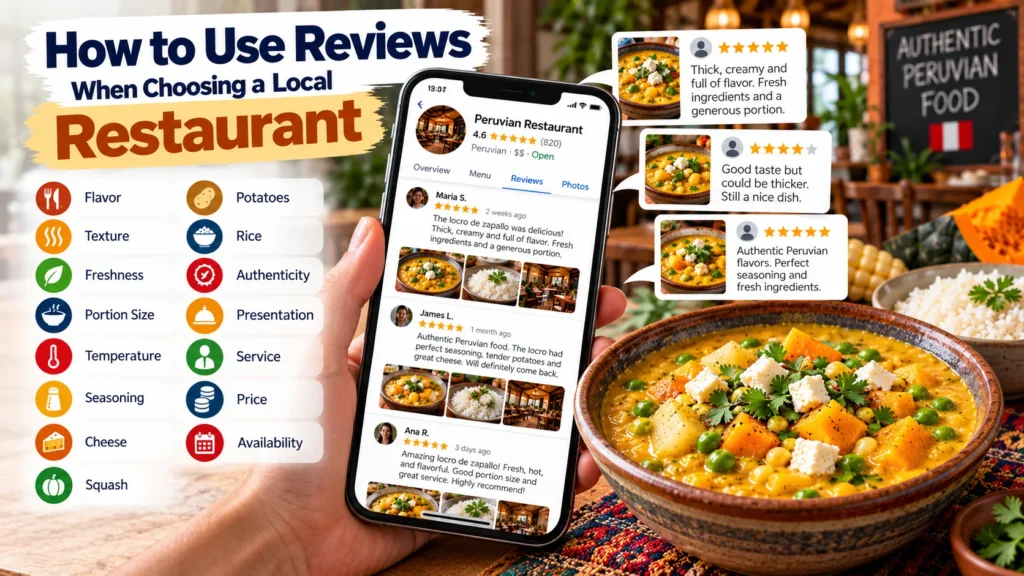
A five-star review saying amazing food does not tell you much about the actual locro.
Instead, look for comments that describe:
- Flavor
- Texture
- Freshness
- Portion size
- Temperature
- Seasoning
- Cheese
- Squash
- Potatoes
- Rice
- Authenticity
- Presentation
- Service
- Price
- Availability
Recent reviews are particularly valuable because restaurant menus and recipes can change.
A review from several years ago may describe a dish that is no longer served.
It is also useful to check photographs uploaded by customers. Images can help you determine whether the dish looks thick and chunky or completely smooth, although appearance alone cannot prove authenticity or quality.
The Texture You Should Expect
Texture is one of the easiest ways to distinguish locro from a conventional blended squash soup.
Many locro preparations are designed to become soft and creamy while still retaining some recognizable vegetable pieces.
‘s recipe cooks the squash and potatoes until they are tender enough to mash while retaining some structure before adding milk, corn, peas, cheese, and cilantro.
That creates a preparation that is:
Soft + thick + creamy + chunky
rather than:
Completely smooth + thin + broth-like
This does not mean every authentic locro must have exactly the same texture. Different cooks may mash the vegetables more or less aggressively.
Traditional Sides That Complete the Dish
Locro de zapallo is often served with something alongside it rather than as an isolated bowl of squash.
White Rice
White rice is one of the most common accompaniments. Peru Delights specifically recommends white rice with its recipe.
Fried Egg
Some modern restaurant and home preparations add a fried egg. ‘s version includes a sunny-side-up egg with the locro and rice.
Fried Plantains
TasteAtlas lists white rice and fried plantains among recommended accompaniments for locro de zapallo.
Fresh Herbs
Cilantro or another fresh herb can add brightness and balance the richness of the stew.
These accompaniments can vary, so their absence does not automatically mean that a restaurant’s version is incorrect.
Vegetarian and Vegan Considerations
Locro de zapallo is often suitable for vegetarian diners, but you should still ask the restaurant about its exact preparation.
categorizes its locro de zapallo as a vegetarian main dish.
However, restaurants can use different stocks, dairy products, and toppings.
If you are vegetarian, ask:
- Is the stock vegetable-based?
- Does the stew contain meat stock?
- Is cheese included?
- Is butter used?
- Is the rice vegetarian?
- Are there any meat-based toppings?
For vegan diners, additional questions are necessary because traditional versions may contain milk, evaporated milk, butter, or cheese.
Ask whether the kitchen can prepare the dish without:
- Milk
- Cheese
- Butter
- Cream
- Animal-based stock
Do not assume that a vegetable-heavy dish is automatically vegan.
view more articles:
- Betterthisworld Money
- Nai Taiyari
- Shortminde com Review
- Vocalnewsmedia com Review
- Contact Gonzay com
- Glorvix com Review
- Adswynk com Review
- Is Crackstube Safe
- Dreamwithjeff com
- Betterthisworld Money
- Techyhittools org
- Lectfect com
- Mercimek Kofte Near Me
Why Ají Amarillo Matters
Ají amarillo is an important ingredient in many Peruvian dishes, and it can give locro de zapallo a distinctive flavor.
Its importance is not simply about making the stew spicy.
It can contribute:
- Chile aroma
- Mild-to-moderate heat
- Fruity notes
- Color
- Savory depth
- Peruvian culinary character
TasteAtlas includes ají amarillo among the characteristic ingredients of locro de zapallo, while Peru Delights uses ají amarillo paste in its recipe.
If a restaurant describes its dish as a traditional Peruvian locro, asking whether ají amarillo is used can help you understand its flavor profile.
Why Different Restaurants May Serve Different Versions
Recipe variation is normal.
One restaurant might prepare locro with:
- Kabocha squash
- Mozzarella
- Whole milk
- Corn
- Peas
- Fried egg
Another might use:
- Traditional pumpkin
- Queso fresco
- Evaporated milk
- Ají amarillo
- Huacatay
- White rice
and Peru Delights demonstrate these differences clearly.
Therefore, authentic should not be interpreted as meaning that only one ingredient list is acceptable.
Instead, consider whether the preparation retains the characteristic identity of Peruvian locro while allowing for reasonable regional, family, or restaurant variation.
Questions to Ask Before Ordering Locro
If you have found a restaurant but the menu description is unclear, a short phone call can prevent disappointment.
Ask:
- Do you currently serve locro de zapallo?
- Is it available today?
- Is it a regular menu item or a special?
- What type of squash do you use?
- Does it contain ají amarillo?
- Is it vegetarian?
- What type of stock is used?
- Does it contain milk?
- What type of cheese is included?
- Does it come with rice?
- Is a fried egg included?
- Is it available for takeaway?
- Can you adjust the spice level?
- Can dairy ingredients be removed?
- What is the serving size?
This is particularly useful because online restaurant menus are not always updated immediately.
Making Locro de Zapallo at Home When You Cannot Find It Nearby
If your local search does not produce a suitable restaurant, you can prepare locro at home.
A practical ingredient list includes:
- Winter squash or pumpkin
- Potatoes
- Onion
- Garlic
- Ají amarillo paste
- Corn
- Green peas
- Vegetable stock
- Evaporated milk
- Queso fresco
- Cilantro or huacatay
- Salt
- Black pepper
- White rice
Peru Delights cooks the onion and garlic first, adds ají amarillo, then cooks the pumpkin, potatoes, corn, and stock until tender. Peas, evaporated milk, queso fresco, and herbs are added toward the end.
‘s version offers another approach using kabocha or butternut squash, Yukon Gold potatoes, milk, peas, corn, mozzarella, cilantro, rice, and eggs.
These recipes demonstrate that you can maintain the central character of locro while adapting ingredients to what is available locally.
A Better Local Search Strategy
If your first search does not find a good option, do not immediately conclude that the dish is unavailable in your area.

Try combining the dish with different search terms:
- locro de zapallo near me
- best locro de zapallo near me
- Peruvian food near me
- Peruvian restaurant near me
- authentic Peruvian restaurant
- Peruvian squash stew
- locro de zapallo restaurant
- Peruvian vegetarian restaurant
- traditional Peruvian food
- Peruvian food delivery
You can also add your city, neighborhood, or ZIP/postal code to narrow results.
The broader Peruvian restaurant search is particularly useful because smaller restaurants may not have optimized their websites around the exact English-language phrase best locro de zapallo near me.
A Simple Checklist for Choosing the Best Option
Before placing your order, compare your options using this checklist:
| What to Check | Why It Matters |
| Current menu | Confirms the dish is actually available |
| Recent reviews | Shows current customer experience |
| Restaurant specialty | Peruvian-focused restaurants may have stronger culinary context |
| Ingredients | Helps identify the preparation style |
| Texture | Locro is generally thick and substantial |
| Ají amarillo | Adds characteristic Peruvian flavor |
| Squash | The foundation of the dish |
| Potatoes | Important for body and texture |
| Cheese | Common in many traditional versions |
| Rice | A common accompaniment |
| Vegetarian status | Important for dietary requirements |
| Freshness | Affects flavor and texture |
| Price | Helps compare similar portions |
| Customer photos | Provides visual information |
| Availability | Prevents an unnecessary trip |
Conclusion
The search for the best locro de zapallo near me becomes much easier once you know what distinguishes this Peruvian dish from an ordinary pumpkin soup. Traditional versions generally bring together squash, potatoes, vegetables, ají amarillo, dairy or cheese, and herbs to create a thick and comforting stew. Established recipes demonstrate that the exact preparation can vary: one may use queso fresco and evaporated milk, while another may use mozzarella and whole milk. White rice, fried eggs, and fried plantains are also possible accompaniments.
When choosing a restaurant, focus on current availability, Peruvian culinary specialization, ingredient quality, recent customer feedback, texture, and preparation style rather than relying only on a search ranking or star rating. If you cannot find locro locally, you can also recreate the dish at home using winter squash, potatoes, corn, peas, ají amarillo, milk, cheese, and traditional herbs. Whether you discover it at a neighborhood Peruvian restaurant or prepare it yourself, a well-made locro de zapallo should deliver the warm, savory, slightly sweet character that makes this classic Peruvian dish so appealing.
What is locro de zapallo?
How can I find the best locro de zapallo near me?
Search for both locro de zapallo near me and Peruvian restaurants near me, then compare current menus, recent reviews, customer photographs, ingredients, and availability. If the dish is not listed online, contacting the restaurant directly is often the quickest way to confirm whether it is being served.
Is locro de zapallo spicy?
Locro de zapallo can contain ají amarillo, which gives it chile flavor and some heat, but it is not necessarily an extremely spicy dish. The squash, potatoes, dairy, and other ingredients can balance the chile.