
Training advice LLBlogKids is a search phrase associated with practical guidance for parents who want to help children develop better habits, behavior, learning skills, confidence, and independence. LLBlogKids describes its focus as supporting parents, caregivers, and educators with child training, learning, and play resources.
Effective child training is not about forcing children to obey every instruction or expecting adult-level self-control from a young child. It is a gradual process of teaching skills, setting reasonable boundaries, modeling appropriate behavior, and giving children repeated opportunities to practice. The Centers for Disease Control and Prevention similarly emphasizes warmth, routines, household rules, communication, safety, and appropriate discipline as important parts of supporting healthy child development.
Children also develop at different rates, so training should match their age and abilities. A strategy that works for a preschooler may be unsuitable for a toddler, while an older child may be ready for greater responsibility and independent problem-solving.
This guide brings together the useful themes appearing around LLBlogKids training content with established positive-parenting principles. It focuses on practical routines, communication, emotional development, responsibility, learning, behavior guidance, and everyday activities that parents can realistically use at home.
Understanding the Meaning of Training Advice LLBlogKids
The phrase training advice LLBlogKids does not refer to a universally recognized medical, educational, or clinical training system. It is better understood as a search topic surrounding child-training advice, parenting strategies, learning activities, and practical ways of guiding children.
LLBlogKids presents itself as an online resource for parents, caregivers, and educators, with content covering child training, learning, play, and development. Other pages appearing for related searches focus on routines, positive discipline, independence, communication, emotional intelligence, study habits, and age-appropriate responsibilities.
A useful approach is therefore to take the practical ideas behind the topic and evaluate them against established child-development guidance. The goal should be skill development rather than simple obedience. Children need repeated practice because self-regulation and executive-function abilities develop gradually rather than appearing fully formed. Harvard’s Center on the Developing Child explains that executive-function and self-regulation skills support planning, attention, working memory, flexibility, and self-control, and that these abilities develop through experience and practice.
Good training should also preserve the child’s dignity and emotional security. Parents can maintain firm boundaries while remaining calm, respectful, and predictable.
Building the Right Foundation Before Teaching New Skills
Children learn more effectively when the adults around them provide predictable expectations and supportive relationships. Training should therefore begin with the environment rather than with punishment or constant correction.
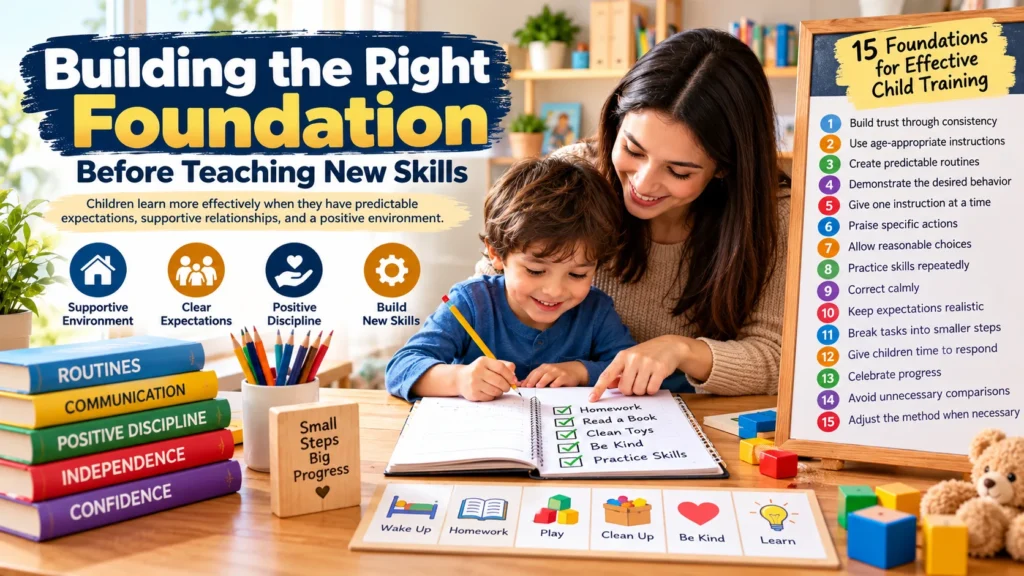
A child who is learning to clean up toys, complete homework, communicate feelings, or follow a bedtime routine needs to know what is expected. Instructions should be simple enough for the child’s developmental level, and parents should demonstrate unfamiliar tasks instead of assuming that the child already understands them.
The CDC recommends routines, household rules, warmth, communication, and appropriate discipline as components of healthy child development. The American Academy of Pediatrics also recommends positive discipline strategies that teach acceptable behavior while supporting healthy development.
15 Foundations for Effective Child Training
Before introducing a new training goal, parents can use these practical foundations:
- Build trust through consistency Keep important promises and follow through on reasonable expectations.
- Use age-appropriate instructions Give children directions they can realistically understand and complete.
- Create predictable routines Regular patterns make everyday tasks easier to anticipate.
- Demonstrate the desired behavior Children learn a great deal by observing adults.
- Give one instruction at a time Multiple commands can overwhelm younger children.
- Praise specific actions Tell children exactly what they did well rather than relying only on general praise.
- Allow reasonable choices Limited choices can give children a sense of independence.
- Practice skills repeatedly Repetition turns unfamiliar actions into familiar routines.
- Correct calmly A correction should teach the desired behavior rather than humiliate the child.
- Keep expectations realistic Developmental differences matter.
- Break difficult tasks into smaller steps Smaller goals can make learning less overwhelming.
- Give children time to respond Young children may need additional processing time.
- Celebrate progress Improvement does not need to be perfect to be meaningful.
- Avoid unnecessary comparisons Comparing siblings or classmates can undermine confidence.
- Adjust the method when necessary If a strategy repeatedly fails, reconsider the approach rather than simply increasing pressure.
Specific praise is particularly useful because it tells a child exactly which behavior should be repeated. The CDC recommends labeled praise, such as identifying the specific action a child performed well, rather than relying only on vague approval.
Using Age-Appropriate Training Strategies
One of the biggest mistakes in child training is expecting the same behavior from every age group. Development changes rapidly during childhood, affecting language, attention, emotional control, independence, and problem-solving.
For toddlers, training may involve simple instructions, imitation, basic routines, language development, and safe independence. The CDC notes that toddlers increasingly imitate adults, follow simple instructions, explore their surroundings, and develop greater independence.
Preschoolers can generally participate more actively in chores, social activities, problem-solving, and routines. CDC guidance for preschoolers recommends clear and consistent discipline, simple choices, reading, chores, and support for problem-solving.
School-age children can gradually take greater responsibility for schoolwork, organization, personal care, household tasks, social relationships, and time management.
Training Priorities by Developmental Stage
Toddlers: Focus on simple language, routines, safe exploration, basic self-help skills, and emotional labeling.
Preschoolers: Add simple chores, manners, turn-taking, problem-solving, dressing skills, and consistent household expectations.
Early school years: Introduce homework routines, organization, responsibility, social problem-solving, and greater independence.
Older school-age children: Increase responsibility for planning, personal belongings, time management, school preparation, and completing tasks without constant reminders.
The purpose is not to accelerate development but to provide opportunities that are appropriate for the child’s current abilities.
Creating Routines That Children Can Follow
Routines are among the most practical forms of training because they reduce the number of decisions children have to make throughout the day. A routine can turn repeated tasks into familiar sequences.
A morning routine might include getting dressed, brushing teeth, eating breakfast, preparing school materials, and leaving on time. An evening routine could include putting belongings away, completing homework, preparing for the next day, brushing teeth, reading, and going to bed.
Routines work best when they are realistic. A schedule containing twenty complicated steps may be harder to follow than a short visual checklist. Parents can also use pictures for younger children who are still developing reading skills.
Practical Routine-Building Methods
Start with one routine that causes frequent difficulty rather than attempting to reorganize the entire day. Break it into recognizable steps and practice the sequence when everyone is calm.
For example, a child who struggles with school preparation might use:
- Pack school bag.
- Check homework.
- Put water bottle in bag.
- Choose clothes.
- Put shoes near the door.
- Set the alarm.
- Go to bed at the planned time.
As the routine becomes familiar, parents can gradually reduce reminders. This helps move responsibility from the adult toward the child.
Teaching Positive Behavior Through Specific Reinforcement
Positive reinforcement is most useful when it identifies the behavior that deserves attention. Saying good job is pleasant, but saying You put your books away without being reminded provides much clearer information.
The CDC explains that praise can increase behaviors parents want children to repeat, especially when praise is specific and uses simple language.
Reinforcement does not have to mean buying presents. Attention, encouragement, recognition, extra family activity, stickers, or a simple high-five can all be appropriate depending on the child’s age and the behavior being taught.
Parents should also avoid turning every ordinary family responsibility into a transaction. Children can learn that some responsibilities are simply part of living together, while positive recognition can still acknowledge genuine effort.
view more articles:
- Betterthisworld Money
- Nai Taiyari
- Shortminde com Review
- Vocalnewsmedia com Review
- Contact Gonzay com
- Glorvix com Review
- Adswynk com Review
- Is Crackstube Safe
- Dreamwithjeff com
- Mercimek Kofte Near Me
- Techyhittools org
- Lectfect com
- StructureSpy Com
Teaching Emotional Intelligence and Self-Regulation
Behavior is often easier to understand when parents look at the emotion or unmet skill behind it. A child who cannot yet explain frustration may cry, shout, withdraw, or become physically upset.
Teaching emotional vocabulary gives children another way to communicate. Parents can introduce words such as happy, worried, disappointed, frustrated, excited, nervous, angry, calm, and proud.
Self-regulation develops gradually. Harvard’s Center on the Developing Child identifies executive function and self-regulation as important skills for managing information, focusing attention, making decisions, and controlling behavior. These abilities develop through interactions and practice.
Useful activities include:
- Naming emotions during everyday situations.
- Reading stories involving different feelings.
- Practicing slow breathing when calm.
- Using drawing to express emotions.
- Taking short breaks during overwhelming activities.
- Practicing turn-taking games.
- Playing memory and matching games.
- Talking about possible solutions after conflicts.
- Modeling calm communication.
- Helping children recognize physical signs of frustration.
The objective is not to eliminate difficult emotions. Children need to learn that emotions are normal while certain actions are not acceptable.
Teaching Responsibility Through Everyday Activities
Responsibility becomes easier to learn when children can practice it in real situations. Household tasks can become learning opportunities rather than simply chores.
Younger children might put toys away, place dirty clothes in a basket, or help organize books. Older children may prepare school materials, help with simple household cleaning, care for personal belongings, or participate in family planning.
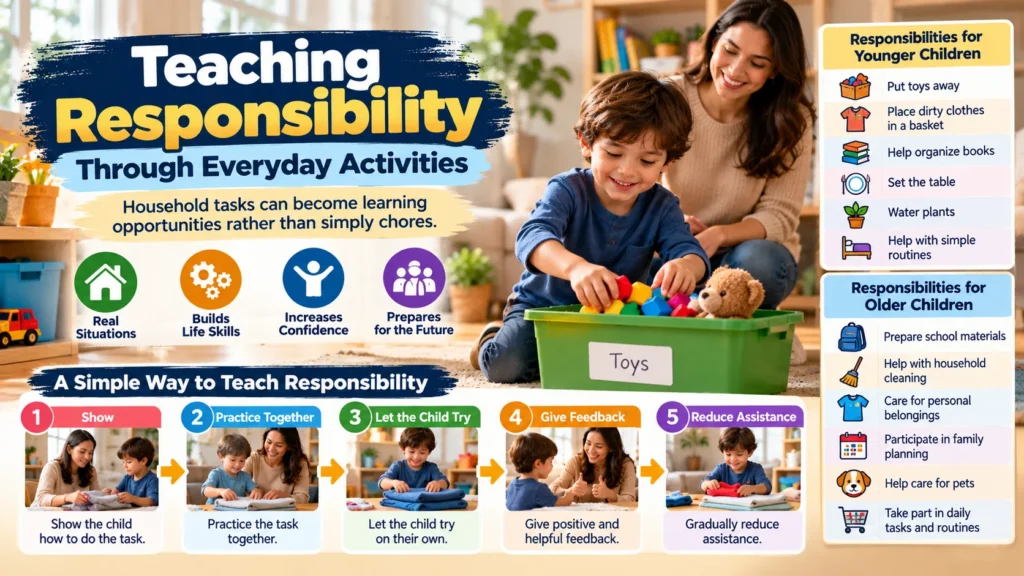
Responsibility should increase gradually. A child who is given a task that is far beyond their abilities may become frustrated, while a task that is too easy may provide little opportunity for growth.
Parents can use a simple sequence:
Show → Practice together → Let the child try → Give feedback → Reduce assistance.
This approach allows the child to experience successful completion rather than becoming dependent on an adult doing the task.
Supporting Learning Without Turning Home Into a Classroom
Training advice for children should include learning, but learning does not need to mean constant worksheets or formal lessons. Everyday experiences can develop language, reasoning, memory, creativity, and problem-solving.
Reading together is especially practical because it can combine vocabulary development with conversation and imagination. The CDC recommends reading with young children and encouraging activities that support language and exploration.
Parents can also use:
- Cooking to practice measurement and sequencing.
- Shopping to practice numbers and decision-making.
- Gardening to discuss nature and observation.
- Puzzles to develop problem-solving.
- Board games to practice rules and turn-taking.
- Storytelling to develop language.
- Building blocks to explore shapes and balance.
- Drawing to encourage creativity.
- Sorting games to practice classification.
- Simple household projects to teach planning.
Harvard’s executive-function resources specifically include age-appropriate activities and games designed to support executive-function and self-regulation skills from infancy through adolescence.
Developing Communication Skills Through Daily Interaction
Communication training begins with ordinary conversations. Children need opportunities to express preferences, describe experiences, request help, disagree respectfully, and explain emotions.
Parents can model the language they want children to use. Instead of responding only to shouting, an adult can calmly provide an alternative phrase such as Please help me or I am frustrated.
Active listening also matters. Parents can pause, listen, acknowledge what the child said, and then provide guidance when necessary.
Communication Habits Worth Practicing
Children can gradually learn to:
- Say please when making reasonable requests.
- Say thank you after receiving help.
- Apologize when an apology is appropriate.
- Ask before taking another person’s belongings.
- Wait for a conversational turn.
- Explain problems using words.
- Ask for clarification when confused.
- Tell an adult when they feel unsafe.
- Disagree without insulting others.
- Listen while another person is speaking.
These are social skills that require repeated practice rather than a single lecture.
Managing Misbehavior With Positive Discipline
Discipline should teach children what to do next. The American Academy of Pediatrics describes positive discipline as a way to teach behavior while supporting healthy development and keeping children safe.
When a child breaks a rule, parents can first identify the behavior, state the boundary, and explain the expected alternative. Consequences should be reasonable, related where possible, and consistent.
For example, if a child throws a toy during an argument, the parent can calmly stop the unsafe behavior and temporarily remove the toy if appropriate. Once the child is calm, the adult can help them practice a safer way to express frustration.
Harsh physical punishment, humiliation, insults, and threats are not necessary components of effective child training. A calm approach can still be firm.
Building Confidence Without Creating Pressure
Confidence grows through experience, competence, encouragement, and opportunities to make decisions. Children should have chances to attempt age-appropriate tasks without an adult immediately taking over.
Parents can acknowledge effort while also giving honest feedback. Instead of praising every outcome as perfect, they can recognize persistence, improvement, careful thinking, or responsible behavior.
Useful phrases include:
- You kept trying after the first attempt did not work.
- You remembered the next step.
- You solved that part by yourself.
- You asked for help in a respectful way.
- You corrected your mistake.
- You worked carefully.
This kind of feedback connects confidence to actions rather than creating pressure to appear naturally talented.
Integrating Technology Into Healthy Child Training
Technology can be useful for learning, communication, creativity, and entertainment, but children also need offline experiences. A family media plan can help parents establish predictable expectations around devices.
For younger children, parents should pay attention to the content being used and maintain opportunities for physical activity, conversation, sleep, reading, creative play, and family interaction. CDC guidance for toddlers and preschoolers includes recommendations around limiting screen exposure and developing a family media approach.
Instead of treating technology as automatically good or bad, parents can ask whether a particular activity supports the child’s needs and fits into the family’s routine.
Using Training Advice LLBlogKids for Practical Daily Activities
The related LLBlogKids material emphasizes routines, learning, behavior, emotional skills, independence, and practical activities. These themes can be translated into simple daily activities without treating LLBlogKids itself as a medical or clinical authority.
A useful weekly plan could include:
Monday Responsibility: Give the child one age-appropriate household task.
Tuesday Reading: Read together and discuss the characters or events.
Wednesday Emotional skills: Name emotions and practice a calming strategy.
Thursday Problem-solving: Complete a puzzle, building activity, or practical challenge.
Friday Communication: Practice listening, turn-taking, and respectful requests.
Saturday Independence: Allow the child to complete an appropriate self-care task independently.
Sunday Reflection: Talk about something the child learned, improved, or enjoyed during the week.
Short, repeated activities are usually easier to maintain than elaborate programs that parents cannot realistically continue.
Common Child-Training Mistakes to Avoid
Even well-intentioned parents can accidentally make training harder. One common mistake is giving too many instructions at once. Another is changing a rule repeatedly, which makes expectations unpredictable.
Parents should also avoid expecting immediate results. A child may need many repetitions before a new routine becomes familiar.
Other problems include correcting every minor behavior, using vague instructions, comparing siblings, completing every task for the child, or relying entirely on rewards.
The aim should be steady improvement rather than perfect behavior.
15 Mistakes That Can Weaken Training Progress
- Expecting adult-level self-control from young children.
- Giving instructions that are too complicated.
- Changing important rules without explanation.
- Using vague commands such as behave.
- Correcting behavior without teaching an alternative.
- Ignoring positive behavior while focusing only on mistakes.
- Comparing one child with another.
- Doing every difficult task for the child.
- Giving consequences that are unrelated or excessive.
- Expecting a new routine to work perfectly immediately.
- Using embarrassment as a teaching method.
- Turning every household responsibility into a reward transaction.
- Ignoring developmental differences.
- Trying too many training goals simultaneously.
- Forgetting to adjust the strategy when the child needs additional support.
A parent does not need to implement every technique at once. Choosing one or two meaningful goals can make the process much more manageable.
Creating a Simple Child Training Plan
A practical plan can be built around one behavior, one routine, or one skill at a time.
Start by identifying the exact skill. Become more responsible is too broad, while put school materials in the bag before bedtime is measurable.
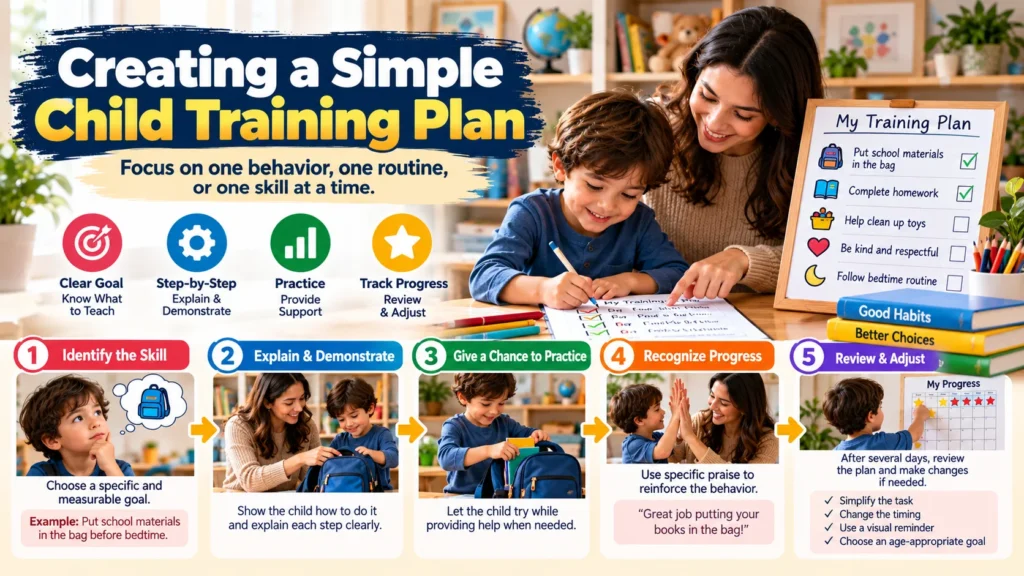
Next, explain and demonstrate the behavior. Give the child an opportunity to practice while providing help when needed.
Then recognize progress. Specific praise can reinforce the behavior the parent wants repeated.
Finally, review the plan after several days. If the child is struggling, simplify the task, change the timing, provide a visual reminder, or choose a more developmentally appropriate goal.
This makes training a flexible process instead of a rigid test.
When Parents Should Seek Additional Developmental Guidance
Most childhood behavior is part of normal development, but parents may sometimes have concerns about communication, learning, behavior, movement, social interaction, or developmental progress.
The CDC emphasizes that children develop at different rates and provides developmental milestone resources for families.
Parents who have persistent concerns should discuss them with the child’s pediatrician or another qualified child-development professional rather than relying exclusively on internet advice. This is especially important when a concern affects safety, communication, learning, daily functioning, or relationships.
Online parenting articles can provide general ideas, but they cannot replace an individualized professional assessment.
A Practical Training Advice LLBlogKids Checklist
Parents looking for a concise version of the training advice LLBlogKids topic can use this checklist as a starting point:
- Build a warm and secure relationship.
- Set a small number of clear expectations.
- Match tasks to the child’s developmental level.
- Create predictable routines.
- Demonstrate unfamiliar skills.
- Break complex activities into smaller steps.
- Use specific positive praise.
- Give limited choices when appropriate.
- Teach children to identify emotions.
- Practice self-regulation skills.
- Encourage age-appropriate independence.
- Include children in simple household responsibilities.
- Read and talk together regularly.
- Use play as a learning opportunity.
- Model respectful communication.
- Correct behavior calmly.
- Avoid physical punishment and humiliation.
- Keep technology balanced with offline activities.
- Review progress instead of demanding perfection.
- Seek professional guidance when developmental concerns persist.
Conclusion
Training advice LLBlogKids is best approached as a practical parenting topic rather than a single rigid training formula. The most useful principles are consistent across many reputable child-development resources: provide warmth, establish predictable routines, set clear boundaries, teach skills directly, encourage positive behavior, support emotional development, and gradually increase independence. The CDC emphasizes routines, positive interactions, communication, developmental awareness, and appropriate discipline, while the American Academy of Pediatrics recommends positive discipline that teaches children acceptable behavior.
Children are not miniature adults, and effective training must account for developmental differences. Toddlers may need short instructions and repeated demonstrations, preschoolers can begin taking on simple responsibilities, and older children can gradually manage more complex tasks independently.
The strongest approach is usually calm, consistent, practical, and flexible. Parents do not need to create a complicated program. One routine, one responsibility, or one emotional skill practiced consistently can become a meaningful part of a child’s development.
What does training advice LLBlogKids mean?
Training advice LLBlogKids generally refers to online guidance connected with child training, parenting, learning, routines, behavior, and children’s development. LLBlogKids describes its platform as a resource for parents, caregivers, and educators.
Is LLBlogKids a professional child-development organization?
LLBlogKids presents itself as an online educational and parenting resource. Parents should distinguish its general articles from guidance issued by pediatric, governmental, or academic organizations and verify health or developmental concerns with qualified professionals.
What is the best way to train children?
A practical approach combines clear expectations, predictable routines, modeling, repetition, positive reinforcement, age-appropriate responsibilities, and calm correction. The exact method should be adapted to the child’s developmental level.
How can parents encourage good behavior?
Parents can give specific praise when children demonstrate behaviors they want repeated. The CDC recommends labeled praise because it clearly identifies the behavior receiving positive attention.
How can routines help children?
Routines give children predictable sequences for recurring activities such as waking up, preparing for school, completing homework, cleaning up, and getting ready for bed. Predictability can make expectations easier to understand and practice.
How can parents teach responsibility?
Parents can begin with small, age-appropriate tasks such as putting toys away, organizing books, preparing school materials, or helping with simple household activities. Responsibility can increase gradually as the child’s abilities develop.