
An honest review of Betterthisworld money based on reading the site whether the advice is sound, who wrote it, and why that matters for money content. is a phrase attached to a live website publishing personal finance content budgeting, saving, debt, investing and income. This review is based on actually reading it. The short version is more nuanced than most reviews of unfamiliar sites: the financial advice on the main page is largely conventional and not harmful, but almost everything around it who wrote it, what the site actually is, and what else it publishes should change how much weight you give it.
What the Site Actually Is
Behind the phrase is a WordPress site running Google advertising, published in late 2025 and updated through 2026. Its main article lays out a personal finance philosophy: treat money as a tool rather than a goal, build habits that match your values, and prefer steady progress to risky shortcuts. It reads as a single long guide covering mindset, budgeting, saving, spending, debt, investing, income and long term planning.
- A WordPress site publishing personal finance content
- Runs Google advertising as its visible revenue model
- Published in late 2025, with updates into 2026
- The main page is one long guide covering the full money basics
- Content is written for a United States audience throughout
- Free to read, with no paywall, login or product to buy
But the Categories Tell a Different Story
Look at the category list and the picture changes. Alongside Finance and Money sit Home Improvement, Home Security, Interior Design, Garden and Real Estate. The recent posts confirm it: articles on wall mounted shelves for apartments, how garage door installation has changed, and how industrial supplies for waterproofing are sourced for large projects, sitting directly beside articles on researching stocks and building a business.
- Categories include garden, interior design and home security
- Recent posts cover shelving, garage doors and waterproofing supplies
- Industrial supplies articles sit beside investing articles
- Home services and industrial topics are standard placement categories
- A finance publication has no editorial reason to cover them
- This is a multiniche site with a financebranded front page
Is Financial Advice Actually Any Good?
This deserves a fair answer, and the fair answer is that most of it is fine. The main guide recommends building an emergency buffer before anything else, budgeting from takehome pay with essentials first, taking any employer retirement match available, using index funds rather than picking stocks, contributing regularly through market swings, rebalancing annually, and choosing between paying the smallest debt first for motivation or the highest interest rate first for cost. That is broadly what most mainstream financial education says.
- Emergency fund before other goals standard advice
- Budget from takehome pay with essentials prioritised standard
- Take the employer retirement match universally recommended
- Index funds over stock picking mainstream consensus
- Regular contributions through volatility conventional
- Snowball versus avalanche debt methods both are recognised approaches
- Nothing on the page is dangerous or unusual
So What’s the Problem?
The advice being unobjectionable is not the same as the source being reliable, and on money content that distinction matters more than anywhere else. Generic advice is safe precisely because it is generic it applies to nobody in particular. The moment your situation involves anything specific, you need a source that can be held accountable for what it tells you, and this site cannot be.
- Generic advice is safe because it fits nobody specifically
- Real financial decisions are always specific
- Safe writing does not make a source authoritative
- Accountability is what separates advice from content
- This site offers no accountability of any kind
Who Wrote It?
Nobody you can identify. The site’s own metadata attributes the main article to Admin. There is no author name, no biography, no stated qualification, no financial credential and no editorial team page. For a site telling readers how to handle retirement accounts, debt consolidation and investment allocation, that is the central problem.
- The main article is attributed to Admin
- No author name or biography appears anywhere
- No financial qualification or credential is stated
- No editorial team or masthead exists
- No regulatory registration or disclaimer is visible
- On money content, this is the finding that matters most
Why Credentials Matter More on Money Than Anywhere Else
Search quality guidelines classify financial content as YMYL Your Money or Your Life material capable of affecting a reader’s financial wellbeing. In most countries, giving personalised financial advice is a regulated activity requiring authorisation, precisely because bad advice causes lasting harm. General education is not regulated, and this site stays on the general side of that line. But a reader cannot tell where general education ends and personal advice begins, which is exactly why the identity of the writer is supposed to be visible.
- Financial content is classified as YMYL by search guidelines
- Personalised financial advice is a regulated activity in most countries
- General education is not regulated, and this site stays general
- Readers cannot easily tell general from personal advice
- Author identity is the safeguard that is missing here
- Regulated advisers carry accountability that anonymous sites do not
view more articles:
- Los Boquerones
- Shortminde com Review
- Vocalnewsmedia com Review
- Contact Gonzay com
- Glorvix com Review
- Adswynk com Review
- Is Crackstube Safe
- Dreamwithjeff com
- Techyhittools org
No Sources, Anywhere
The article makes several factual claims and supports none of them. It refers to surveys and economic data showing households struggle to save, without naming any. It mentions variation in the United States personal saving rate without giving a figure, a period or a source. That specific statistic is published monthly by a US federal agency and would take one link to support.
- Claims about survey and economic data appear without citation
- The personal saving rate is referenced with no figure or period
- That figure is published monthly and freely available
- Not a single external source is linked in the main guide
- Unsourced claims cannot be checked by a reader
- Real finance publications cite their data as standard practice
The Writing Itself Raises Questions
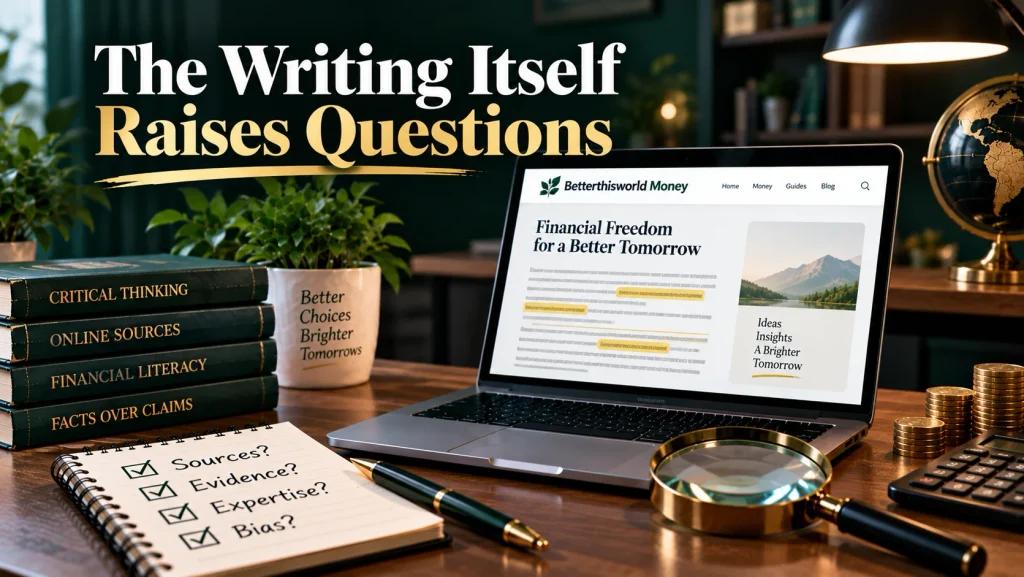
Read a few paragraphs closely and the phrasing is intermittently odd in a specific way. Sentences like Your family appears to be protected by saving and What you leave behind is merely one aspect of your legacy are grammatically fine but structurally unnatural the kind of construction that appears when text has been generated or heavily rewritten rather than written. It does not make the advice wrong. It does suggest the content was produced at volume rather than authored.
- Several sentences use unnatural passive constructions
- Phrasing patterns are consistent with generated or rewritten text
- The advice itself remains conventional despite this
- Production at volume is not the same as authorship
- It explains the absence of citations and personal experience
- Nothing in the guide reflects lived experience or a specific case
The Internal Link Pattern
One more structural detail is worth noticing. The main article repeatedly links out to other pages on the same site using brandvariant phrases as the anchor text different arrangements of the same brand name, plus several related brand terms that appear to belong to a wider connected cluster of sites. Those links are inserted midsentence in places where they add nothing for a reader.
- Internal links use brand name variants as anchor text
- Several related brand terms suggest a connected cluster of sites
- Links are inserted where they serve no reader purpose
- This is search optimisation of the site’s own brand terms
- It explains why the brand generates search volume at all
- Content shaped this way is written for ranking, not reading
The Geography Mismatch
The content is written explicitly for a United States audience it references US retirement account types, American households and US saving rates throughout. Yet the largest single source of search interest in this brand comes from France, with Germany also significant. Advice built around USspecific taxadvantaged accounts is of limited practical use to a French or German reader, since the equivalent products, tax treatment and rules are entirely different.
- Content references US specific retirement account types
- It addresses American households and US economic data
- The largest source of search interest is France
- Germany is also a significant source
- US taxadvantaged accounts have no French or German equivalent
- Readers outside the US should treat the specifics as inapplicable
Is Betterthisworld Money a Scam?
No. The site takes nothing from visitors there is no payment form, no account creation, no product for sale, no newsletter capture requiring personal details and no downloads. It carries advertising, which is an ordinary way to fund a website. Nobody reading it is at risk of losing money to the site itself. The concerns are entirely about how much authority to grant unattributed financial content on a multiniche advertising site.
- No payment requests or product sales
- No account creation or personal data collection
- Advertisingfunded, which is an ordinary model
- No direct financial risk from the site itself
- Concerns are about authority, not fraud
- Reading it is harmless; relying on it is the question
How to Use It Sensibly
There is a reasonable way to treat a site like this, and it is not to dismiss it entirely. General financial concepts are genuinely useful to encounter, and someone completely new to budgeting will not be harmed by reading that emergency funds come first.
- Use it to learn that a concept exists nothing further
- Verify every specific figure, rule or account type elsewhere
- Never act on unattributed advice about your own accounts
- Ignore anything USspecific if you are not in the US
- Crosscheck retirement and tax rules with an official source
- Treat it as a starting point, not a plan
Where to Get Financial Information You Can Actually Rely On

For anything that affects real money, better sources exist and most of them are free.
- Government financial guidance bodies free, regulated and countryspecific
- National consumer financial protection agencies for debt and credit
- Regulated free debt advice charities for anyone struggling with repayments
- Your pension or retirement provider’s own documentation authoritative on your product
- Central bank and statistics agency data for actual economic figures
- A regulated financial adviser for anything specific to your situation
- Check any adviser’s registration on your national regulator’s public register
How to Assess Any Finance Website
This checklist works on any money site you encounter and takes about five minutes.
- Find the author’s name and stated qualifications
- Search for that name. Do they exist as a finance professional?
- Look for a regulatory registration number or a clear not advice disclaimer
- Check whether factual claims link to primary sources
- Check the publication and last updated dates on the article
- Look at the site’s other categories is finance the actual focus?
- Check which country the advice assumes you live in
- Look for an editorial policy or corrections process
- Be wary of any site combining finance with unrelated home services content
- Compare its guidance against a government financial guidance body
Conclusion
Better this world money is a real, live, advertising funded website whose main personal finance guide contains advice that is broadly conventional and not harmful. That is worth saying clearly, because a lot of unfamiliar sites cannot claim as much. What it lacks is everything that would let you rely on it: a named author, any stated qualification, a single cited source, a regulatory disclaimer, and a coherent focus the same site publishes on garage doors, garden equipment and industrial waterproofing supplies. Read it to encounter ideas. Verify anything you would act on with a source that can be held responsible for what it tells you.
- The financial advice on the main page is conventional and not harmful
- No author, credential, source or disclaimer appears anywhere
- The site is multiniche, not a finance publication
- Content assumes a US reader while most search interest is European
- Fine for learning concepts; not a basis for financial decisions
What is Betterthisworld money?
A phrase attached to a live WordPress site publishing personal finance content on budgeting, saving, debt, investing and income, alongside unrelated categories including home improvement, garden and real estate.
Is the financial advice on it accurate?
Broadly, yes. The main guide recommends emergency funds, employer retirement matches, index funds and regular contributions all mainstream advice. It is generic rather than wrong
Is Betterthisworld money legit?
It is a real, functioning website that asks nothing of visitors and sells nothing. It is not a verifiable financial publication, since no author, credential, source or regulatory disclosure appears anywhere on it.
6 Responses